
The San Diego housing market has officially entered its fall season.
Buyer demand is down. Homes are taking longer to sell. And the overall pace of the market is considerably slower than it was this spring.
So does that mean buyers should expect big discounts?
Not necessarily.
That's one of the most important distinctions to understand about today's San Diego housing market.
A slower market gives buyers more negotiating leverage.
But more leverage and dramatically lower home prices aren't the same thing.
Welcome to the Fall Market
Real estate is highly seasonal.
In San Diego, the Fall Market generally begins around the end of August and continues until the week before Thanksgiving. From there, we enter the even slower Holiday Market.
Typically, two things happen during fall:
Fewer buyers shop for homes, and fewer homeowners list them.
According to the latest San Diego County housing report from Steven Thomas, the average number of new listings over the past three years falls from approximately 3,400 in May to 2,853 in September—a decline of about 16%.
At the same time, families settle into the school year, summer vacations end, and buyer activity gradually declines.
This year, that slowdown is already underway.
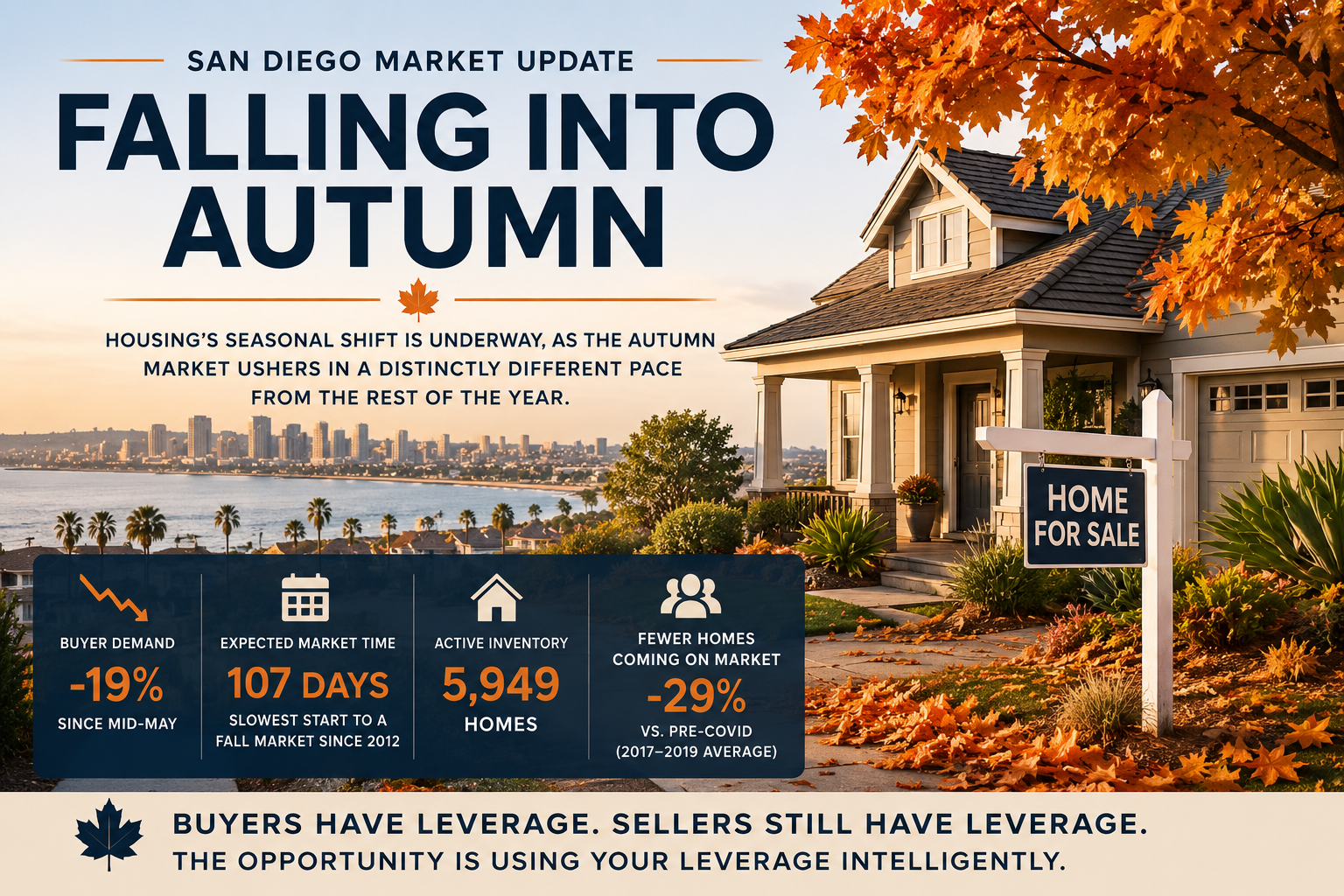
Buyer Demand Has Fallen 19% Since May
Buyer demand peaked in mid-May at 2,046 pending sales.
Today, there are 1,661—a decline of approximately 19%.
Meanwhile, there are currently 5,949 active listings across San Diego County.
With both supply and demand declining at roughly the same pace over the past two weeks, expected market time has remained unchanged at 107 days.
For perspective, market time was just 80 days in May and 99 days at the beginning of last year's Fall Market.
According to the report, 107 days represents the slowest start to the Fall Market since tracking began in 2012.
On the surface, that sounds like the setup for a buyer's market.
But there's another side to the equation.
Sellers Aren't Flooding the Market
One of the unusual features of today's housing market is how few homeowners are selling.
Through August, 29% fewer homes were listed in San Diego County compared with the 2017–2019 pre-COVID average.
Many homeowners are still sitting on mortgage rates dramatically below today's rates.
Others have significant equity and simply don't have an urgent reason to move.
That matters because housing prices aren't determined simply by how many buyers are shopping.
They're determined by the relationship between buyers who want to buy and sellers who are actually willing—or need—to sell.
And right now, there simply aren't enough distressed or highly motivated sellers to create widespread fire-sale pricing.
The report shows only 94 distressed properties—foreclosures and short sales combined—on the market across San Diego County. They represent just 1.6% of active listings.
That's hardly the foundation for a foreclosure-driven housing crash.
So Where Is the Buyer's Leverage?
This is where I think buyers need to change the way they think about getting a "deal."
A deal doesn't always mean buying a $1.2 million house for $1 million.
In today's market, leverage can show up in several different ways:
- Negotiating repairs after an inspection
- Receiving a seller credit toward closing costs
- Negotiating an interest-rate buydown
- Getting favorable timing or contingency terms
- Buying a home that has been sitting on the market
- Simply avoiding a bidding war and having time to perform proper due diligence
And yes, there are absolutely homes where price negotiation is possible.
But the opportunities tend to be property-specific rather than market-wide.
That's an important distinction.
Sellers Need to Understand the Same Dynamic
There's a flip side to this for sellers.
You may not be forced to dramatically discount your home.
But buyers aren't forced to buy your home either.
They have more time and more choices.
That means the strategy of listing high "just to see what happens" becomes increasingly dangerous as the market slows.
A correctly priced home can still attract buyers.
An overpriced home can sit while buyers choose better alternatives.
That's why the report specifically emphasizes precise pricing as we enter the Fall Market.
What People Are Getting Wrong
Here's the misconception I think is worth correcting:
A slower housing market doesn't automatically mean dramatically lower home prices.
Market time tells us how quickly homes are selling.
Price is determined by what buyers and sellers ultimately agree to.
Those things are related—but they're not identical.
Today's market is giving buyers more negotiating power without creating widespread seller distress.
That's why this isn't a market where I'd recommend waiting around for some giant "SALE" sign to appear over San Diego real estate.
Instead, I'd look for individual situations where your leverage is strongest.
A home that's been sitting.
A seller whose timing matters.
A property with cosmetic problems other buyers are overlooking.
Or simply a situation where you can negotiate terms that make the economics of the purchase significantly better.
That's how you find opportunities in a slower market.
Not by waiting for every home in San Diego to suddenly go on sale.
Check out this article next