
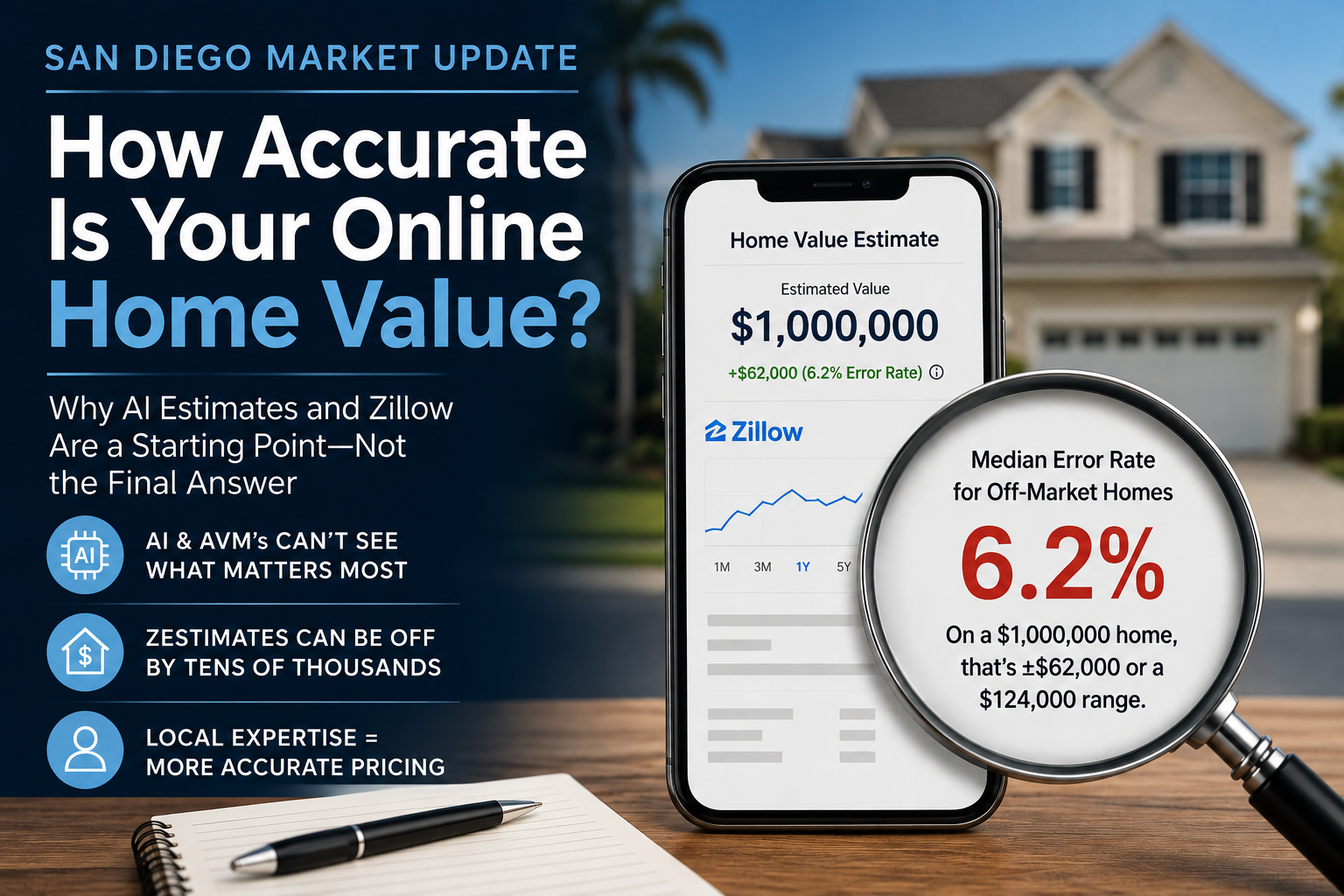
How Accurate Is Your Online Home Value? What San Diego Homeowners Should Know in 2026
It's never been easier to find out what your home is "worth."
Type your address into Zillow and you'll have an estimate in seconds. Ask an AI chatbot and it can analyze comparable sales, neighborhood trends, price per square foot, and seemingly endless amounts of housing data.
That's incredibly useful.
But there's an important distinction homeowners should understand:
An automated home valuation is an estimate. Fair market value is something different.
The latest San Diego County housing report from Steven Thomas illustrates just how large that difference can sometimes be.
How Accurate Are Online Home Values?
Thomas's report uses Zillow's Zestimate as an example.
For San Diego homes already listed for sale, Zillow reports a median error rate of approximately 1.64%.
That's pretty impressive.
But there's an important catch.
Once a property is listed, Zillow has considerably more information. It can incorporate the asking price and listing description, including information about condition and improvements.
For off-market homes, which is usually when a homeowner is looking online trying to determine what their property might be worth, the median error rate increases to 6.2%.
On a home estimated at $1 million, 6.2% represents $62,000 in either direction.
That creates a possible range from roughly $938,000 to $1,062,000.
For someone deciding whether to sell, refinance, remodel, or purchase another property, that's a pretty meaningful difference.
Why Can an Algorithm Be Wrong When It Has So Much Data?
This is where I think the conversation gets interesting.
We tend to assume that more data equals more certainty.
But real estate doesn't work entirely that way.
Imagine two 1,800-square-foot homes on the same street.
On paper, they might look almost identical.
But one could have a great floor plan, beautiful natural light, a remodeled kitchen, privacy and an ocean peek.
The other could back up to traffic, have an awkward layout and need $150,000 worth of updating.
Those aren't minor details to a buyer.
They're often the difference between competing offers and sitting on the market.
An algorithm can incorporate more of these variables than ever before, but it still doesn't experience a property the way a buyer does.
Thomas specifically identifies factors such as condition, upgrades, views, privacy, lot characteristics, floor plan, curb appeal, craftsmanship, amenities, deferred maintenance and location nuances as things automated valuations can miss.
AI Isn't the Problem
I think it's important not to take the wrong lesson from this.
AI is an extraordinarily useful real estate tool.
I use it myself.
Automated valuations are useful too.
The mistake is expecting either one to answer a question they're better suited to begin answering.
If you're simply curious whether your house is worth roughly $900,000 or $1.2 million, an automated estimate may be perfectly adequate.
If you're deciding whether to list at $1,025,000 or $1,075,000, you need considerably more precision.
That's where you start looking closely at recent comparable sales, pending sales, current competition, property condition and—critically—how buyers are behaving right now.
And Right Now, Pricing Matters More
There's another reason this conversation is particularly relevant today.
San Diego's market is moving into its normal autumn slowdown.
Over the past two weeks, buyer demand declined 4%, while inventory increased slightly. That pushed expected market time from 102 to 107 days. Last year at this time it was 99 days.
We're not talking about a housing crash.
In fact, July closed sales were 8% higher than July 2025, and 99.6% of sales involved sellers with equity.
We're talking about a market where buyers have time to be more selective.
And when buyers become more selective, sellers have less room to get the initial price wrong.
What People Are Getting Wrong
Here's what I think people are getting wrong:
More data doesn't automatically mean a more accurate answer.
Determining fair market value isn't purely a math problem.
It's part data and part judgment.
The data tells us what other homes sold for.
The harder job is determining how your home compares to them—and how today's buyers will perceive those differences.
That's why I wouldn't tell a homeowner to ignore Zillow, an AVM, or AI.
Use them.
Just use them for what they're good at: giving you a starting point.
Then, when the number actually matters, take the next step and determine what the market is likely to pay.
Check out this article next